Wrap every piece in clean packing paper, stand the plates on edge like records, and fill every gap before the flaps close. Dishes rarely break from weight. They break from movement, which is why a tightly packed box travels better than a loosely padded one.
We have packed kitchens as professional movers in Santa Maria, CA since 2002. Our crews are permanent ASAP Movers employees, background-checked and trained before they handle anyone’s china. The method below is the one they use, and you can run it yourself over a weekend, you know, no special skills needed.
What You Need Before the Plates Go in a Box
Materials decide most of the outcome here, and the two that matter are the carton and the paper. Dish pack cartons have double-wall sides that resist crushing when a box gets stacked three high in a truck. A standard book box will not do that. Clean newsprint, sold unprinted, wraps without transferring ink onto glaze.
Newspaper looks like a free substitute until you unwrap a white platter with yesterday’s headlines on it. Add wide packing tape, a marker, and cell dividers if you own stemware. Bubble wrap earns its place around a few fragile pieces rather than around everything, since it adds bulk faster than protection.
Our packing services cover cartons and supplies too, and we stock them at our Santa Maria warehouse, so you can pick up dish packs without a trip to three stores. Set up on a cleared table before you start, because packing dishes off a crowded counter is how chips happen. Just trust me on that one.
How to Wrap Plates, Bowls, Cups, and Stemware
Each shape wants a different wrap, and getting that right takes about twenty seconds per piece once your hands learn it. Work through one cupboard at a time, which is one of those simple packing tips that saves you a headache, since a half-emptied cabinet is easy to lose track of. It’s kind of boring, sure, but it works.
- Plates. Lay a sheet of paper flat, set the plate in the middle, pull one corner over, then add a second plate and repeat until you have a bundle of three. Fold the remaining corners around the stack and tape it once.
- Bowls. Wrap each one on its own, then nest two or three with a folded sheet between them. Nesting unwrapped bowls lets the rims grind together on every bump.
- Cups and mugs. Stuff the inside with crumpled paper, wrap the outside, and pay attention to the handle. Handles take the impact first.
- Stemware. Pack each glass upright in a cell divider after wrapping the bowl and the stem separately. Stems snap when a glass lies on its side.
- Platters and serving pieces. Wrap these alone, in two sheets, and stand them on edge against the side of the carton.
Bundles of three plates are the limit worth keeping. Four is heavier than it looks, and the bottom plate in a tall stack carries the load for all of them. Maybe it feels slow, but a bundle of three is just safer.
How to Load the Box So Nothing Shifts
A dish pack is built in layers, and the bottom layer does the work. Start with two or three inches of crushed paper across the base, pressed down so it springs back rather than flattening. That cushion absorbs the drop when a box gets set down hard, which happens on every move no matter who is carrying it.
Stand the plate bundles on edge, side by side, like files in a drawer. Flat stacking is the single most common mistake we see, because a horizontal plate has nothing supporting its center and cracks across the middle. Bowls go in on their sides above the plates. Cups, mugs, and glasses ride on the top layer where nothing presses down on them.
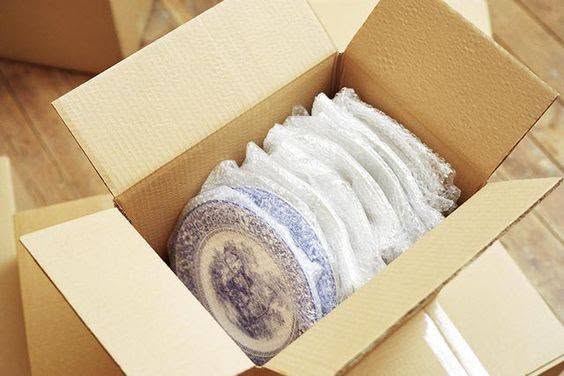
Fill every void as you go, with crumpled paper down the sides, into the corners, and across the top. The flaps should close without bulging, and nothing should move when you tip the box gently. Then tape the seam and run another strip across it.
Write two things on the side: the word fragile, and the room the box belongs in when you’re moving into a new home, not the room it came from. Our crews unload by destination, so a box marked kitchen goes straight to the kitchen instead of into a pile by the door. Sounds small, but it saves a lot of hauling.
Dishes piling up in your Santa Maria kitchen and not sure where to begin? Give us a call at (805) 544-9222, and we’ll take a look before it turns into a bigger problem.
Stemware, Heirlooms, and the Dishes You Still Need This Week
Some pieces should not go in a carton at all. Wedding china that has been in the family for three generations, a single irreplaceable serving bowl, anything you would be sick about losing. Carry those yourself in a padded box on the back seat.
That’s what we tell customers, even though we’re paid to move the rest. No packing method makes an irreplaceable object replaceable. You know what? Some things are just better riding with you.
Set aside an open box for week one too. Four plates, four bowls, four sets of cutlery, two pans, a kettle. Seal it last, mark it clearly, and have the crew load it near the truck door so it comes off early.
That box is the start of settling into the new house, and it matters more than anything else you pack. Move into a house in Santa Maria, California with every dish sealed in identical cartons, and you will eat takeout off paper towels for three days. It gets old fast.
Should You Pack the Kitchen Yourself or Have Us Do It?
The kitchen takes longer than any other room, usually a full day for a family of four. It is also where self-packing goes wrong most often. That makes it the most common room customers hand to us even when they pack everything else themselves.
| Approach | What it asks of you | When it fits |
| Pack it yourself | A weekend, materials bought ahead, patience with wrapping | You have the time, and nothing is irreplaceable |
| Partial pack by our crew | A few hours of access, usually a day or two before the load | Fragile rooms only, kitchen and artwork |
| Full service pack | Clearing access and pointing at what stays | Short notice, a large kitchen, limited physical capacity |
Our packers bring their own cartons, paper and tape, and they clear the debris afterward if you want the unpacking service too. Packing the rest of the house yourself? The same method works for books and lamps, just with a bit less wrapping.
What to Do if Something Arrives Broken
Open the kitchen boxes while the paperwork is still fresh rather than three weeks later. Photograph the damaged piece before you move it and keep the carton it came in. Tell your moving coordinator the same day. Those three steps matter more than anything written on a form.
Our claim form sits in the moving resources section of our website, alongside the non-allowable list and the move day checklist. Read it before your move rather than after something goes wrong.
Ask your coordinator to walk you through what applies to your shipment while you are still deciding who to hire. Any mover worth using will answer that question plainly, and the answer you get is a fair way to judge them.
Frequently Asked Questions
These are the questions our coordinators field most often once a customer starts on the kitchen.
You can, but the ink transfers onto glazed and unglazed surfaces alike, and it is worse on anything that sat in a warm truck. Clean unprinted newsprint costs very little and wraps the same way. If you do use newspaper, keep it off white china and unglazed stoneware entirely.
Standing on edge, every time. A plate lying flat has no support under its center, so the weight of everything above it concentrates on the thinnest point. Stood on edge in a tight row, each plate braces the next, and the whole block moves as a unit rather than as a stack.
Dish pack cartons have double-wall construction that ordinary boxes lack. That is what keeps the sides from folding inward under a stack. A standard box can work for a short carry if it is small and filled tight, but for a loaded truck, the carton is cheap insurance.
Pack it last, a few days before the truck arrives, keeping out the everyday set. Book the move itself much earlier, four to six weeks ahead for a local move and six to eight for a long distance move.
Contact Us for a Free Estimate
Tell us what is in your kitchen, where you are moving, and roughly when, then contact us for a quote. We will tell you how many cartons it takes and what a crew would cost to do it for you. Estimates are free, and we will come to the house to look at the job in person rather than quoting blind over the phone.
ASAP Movers
- Phone: (805) 544-9222
- Email: info@asapmovers.com
- Address: 1310 W McCoy Ln, Santa Maria, CA 93455
Related Topics: